Japanese kitchen knives are precision instruments. The Japanese culinary tradition treats a knife not as a tool you replace every few years, but as something you maintain over decades. With proper care, a quality gyuto, santoku, or yanagiba will outlast its owner. With careless treatment, even a $400 knife can be unusable in six months.
This guide covers the daily, weekly, and longer-term care that protects Japanese knives. Most of it is simple, but each step has a real reason behind it that owners often miss.
The hardness paradox
To understand Japanese knife care, you need to know one thing: Japanese knives are made from significantly harder steel than Western knives. Western chef knives are typically 54 to 58 HRC on the Rockwell hardness scale. Japanese knives are typically 60 to 67 HRC, often higher on premium blades.
Higher hardness means the steel holds a finer, sharper edge for longer. That's why Japanese knives cut so cleanly. But higher hardness also means more brittle. The steel doesn't bend; it chips. Drop a Western chef knife on a tile floor and it might bend or scratch. Drop a Japanese gyuto on a tile floor and it might lose a chunk of cutting edge that cannot be restored.
Almost every care principle that follows comes from managing this paradox: protect the hardness, respect the brittleness.
Higher hardness means a finer edge for longer. It also means more brittle. Protect the hardness, respect the brittleness.
Never use a Western honing steel
This is the single most important rule and the one most owners get wrong. Traditional Western honing steels can damage Japanese knives.
A Western honing steel is itself a hard steel rod, usually around 55 to 60 HRC. It works by pushing the edge of a softer Western knife back into alignment after small deformations from use. The mechanic of the steel is bending the metal of the edge.
Japanese knife steel doesn't bend. It chips or breaks. When you stroke a Japanese knife on a Western honing rod, you're not realigning the edge. You're micro-chipping it. Every stroke removes small pieces from the cutting edge, gradually destroying the edge geometry.
What to use instead:
- A ceramic honing rod, used very lightly (4 to 6 light strokes per side, never grinding hard)
- A leather strop for daily edge maintenance, especially on premium knives
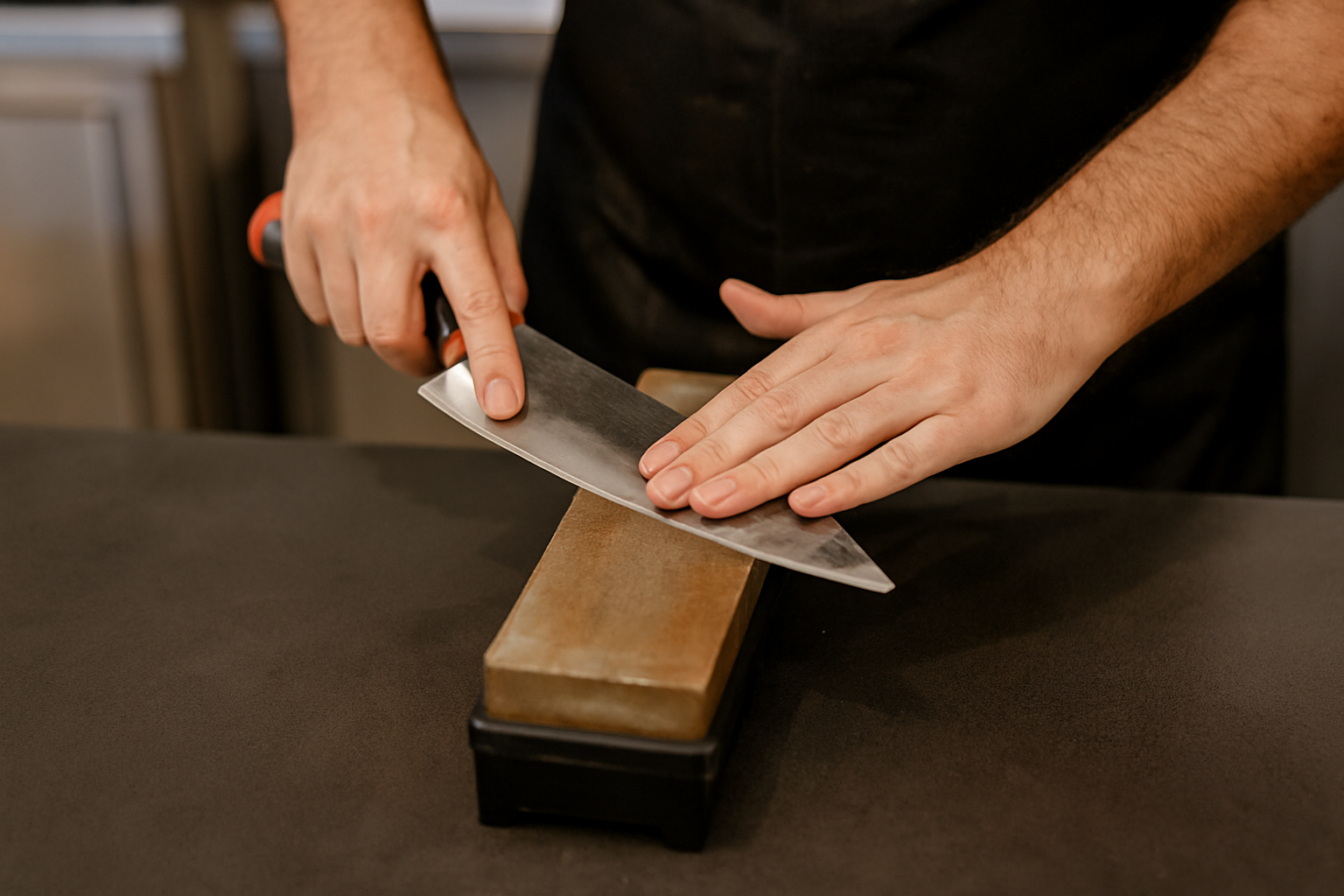
- A whetstone for proper sharpening at intervals (or send to professional sharpening)
- Nothing at all: many Japanese knife users just sharpen more frequently rather than honing between sharpens. This works fine.
Daily cleaning
How you clean matters as much as whether you clean. Japanese knives, especially carbon steel ones, can corrode in minutes if treated wrong.
- Hand wash immediately after use, while still in the kitchen. Don't leave on the bench, don't soak in the sink with other dishes
- Use warm water and mild soap. Wipe with a soft cloth or sponge along the edge, never across it
- Never put in the dishwasher. The combination of harsh detergents, high heat, and the knife knocking against other items causes corrosion, edge damage, and handle warping
- Dry thoroughly with a clean cloth before putting away. Especially critical for carbon steel; a wet carbon blade can develop visible rust within an hour
- If storing long-term (more than a few days unused), wipe with a food-safe mineral oil or camellia oil to prevent oxidation
The cutting surface
Where you cut affects edge life as much as how you cut.
- Use end-grain wood or soft plastic cutting boards. End-grain is the gentlest because the wood fibres absorb the cutting motion rather than resisting it
- Avoid bamboo, glass, ceramic, marble, or stone surfaces. These are harder than the steel and will dull or chip the edge with every cut
- Avoid bones, frozen food, and pumpkin/squash with thick rinds. Japanese knives are precision slicers, not crackers. For these tasks, use a Western knife or a Japanese deba (designed for harder work)
- Don't scrape the edge sideways across the board when you're moving food. Use the spine to scoop or transfer ingredients with a different tool. Sliding the edge sideways dulls it surprisingly fast
- Don't twist the blade in the cut. Japanese geometry is designed for a clean push or pull stroke. Twisting puts lateral force on the edge and can chip it
Storage
Storage is where many otherwise-careful owners damage their knives. The basic principle: nothing else should ever touch the cutting edge.
- Use a magnetic strip mounted on the wall (the most popular professional storage). Hangs the knife by its spine, exposes the edge to air for drying
- Use a knife block with horizontal slots, or one designed specifically for Japanese knives
- Use blade guards (saya in Japanese, plastic edge guards) if storing in a drawer or kit bag
- Never throw loose in a drawer. The edge knocks against everything else, gets damaged, and is unsafe when reaching in
- Don't store wet. Always dry thoroughly before putting away
- Don't store in leather sheaths long-term. Leather can hold moisture and cause corrosion on carbon steel
Carbon vs stainless steel
Japanese knives come in two broad categories: carbon steel (often called Hagane, with names like Aogami/Blue, Shirogami/White, or specific grades like Aogami Super) and stainless steel (VG-10, ATS-314, SG2, R2, ZDP-189, etc.).
Carbon steel
Carbon steel takes a finer edge, holds it longer, and sharpens more easily on whetstones. It's the traditional choice for serious work. The trade-off: it rusts. Quickly. If left wet, it can develop visible rust within minutes.
Carbon care rules:
- Clean and dry immediately after every use, every time
- Apply a light food-safe oil for any storage longer than overnight
- Acidic foods (tomato, citrus, onion) will discolour the blade. This is mostly cosmetic but you can minimise it by washing immediately after
- A patina will develop over time. This is normal and actually protective; the patina is a stable oxide layer that prevents deeper rust. Don't try to scrub it off
Stainless steel
Stainless Japanese knives are easier to live with. They don't rust the same way, don't need oiling, and tolerate slight neglect better. They sharpen on the same whetstones as carbon and take similarly fine edges, though many collectors maintain that carbon takes a slightly finer edge.
For most home cooks, a quality stainless Japanese knife is the practical choice. For chefs willing to invest the daily care, carbon offers slightly superior performance.
The patina explained
Owners often see the dark grey or blue-tinted discolouration that develops on carbon steel and assume it's rust or damage. It's not. A patina is a stable layer of iron oxides that forms naturally as the steel reacts with the food it cuts. It's actually protective.
You can:
- Let it develop naturally (most common)
- Force a patina deliberately by soaking in vinegar and water, mustard, or strong tea (for an even, controlled colour)
- Polish it off with metal cleaner (purely cosmetic; the patina will redevelop quickly)
A well-maintained patina protects the steel from deeper corrosion. The only situation to remove it is if you see active red rust, which is different and does need addressing immediately with a light scrub and oil.
When to professionally sharpen
For most home cooks, every 6 to 12 months on a working knife. For restaurant chefs in daily use, every 2 to 4 months on the primary chef knife. The signs:
- The knife crushes ripe tomatoes rather than slicing them cleanly
- Onions release their tearing compounds harder than they should
- Paper test: a sharp knife slices a sheet of paper cleanly. A dull knife catches and tears
- You find yourself pressing harder than you used to for the same cut
Professional sharpening on whetstones at the original edge angle preserves the Japanese knife's geometry. This is different from Western knife sharpening; the angles are typically 12 to 15 degrees per side rather than 18 to 22 degrees. A Western sharpener using a Western angle on a Japanese knife will progressively flatten the geometry over multiple sharpenings.
Our Japanese knife sharpening service uses whetstones at the correct original angle and preserves single-bevel geometry on yanagiba, deba, and usuba.
Common mistakes
The mistakes we most often see ruining good Japanese knives:
- The dishwasher. Just don't.
- Cutting through bones. Use a Western cleaver or a Japanese deba designed for it.
- Glass cutting boards. Beautiful, terrible for knives.
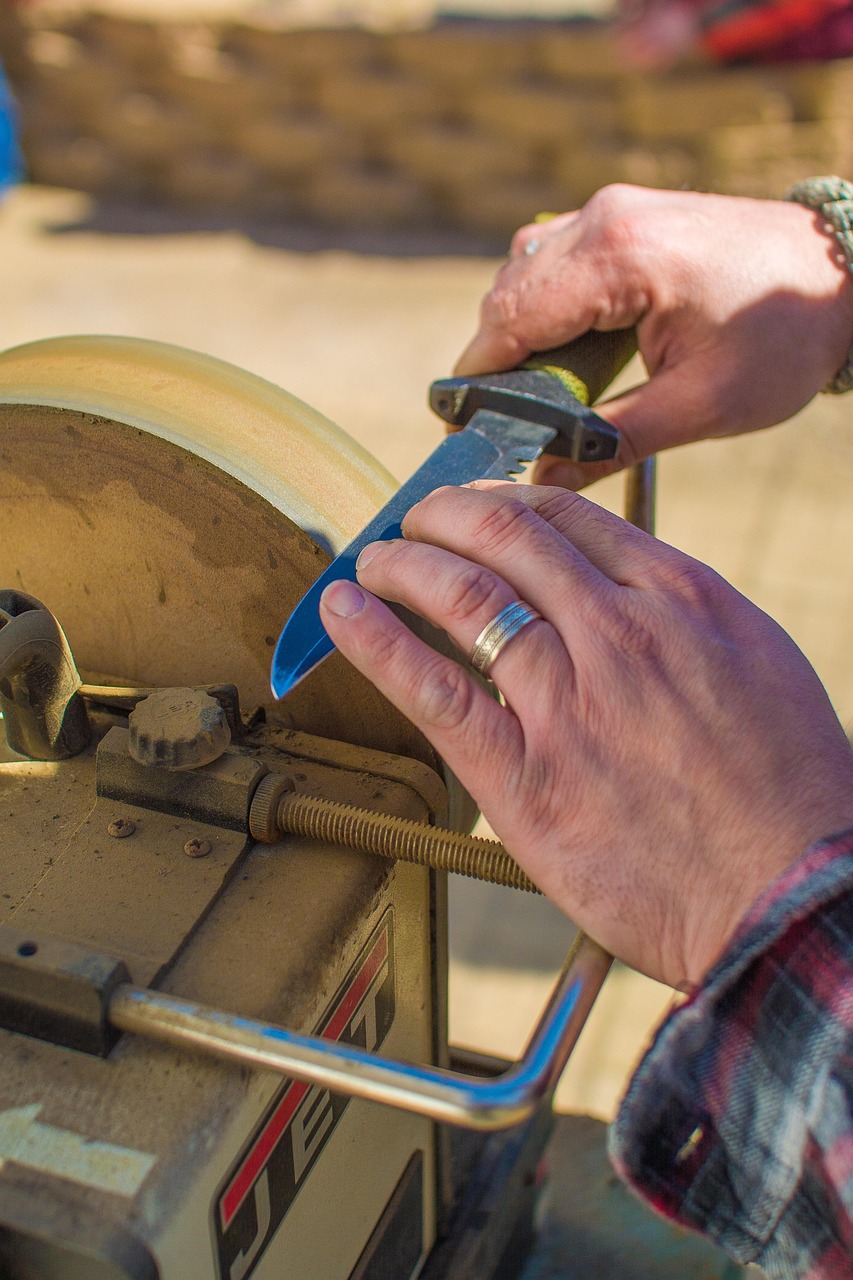
- Pull-through sharpeners. The "knife sharpener" sold next to the dishwashing liquid in supermarkets uses crude carbide cutters that gouge the edge. Never use one on a Japanese knife.
- Honing on a Western steel. Already covered above. Worth saying twice.
- Storing wet. Especially fatal for carbon. Even stainless can develop spotting.
The bottom line
Wash by hand immediately. Dry thoroughly. Store with the edge protected. Cut on wood. Don't drop, don't twist, don't hone on a Western steel. Sharpen professionally every 6 to 12 months at the correct angle.
Done well, a $400 Japanese chef knife will outlast a $40 Western one by decades and provide a noticeably better cut every day in between.
When edges need restoring, our Japanese knife sharpening service uses whetstones at the original edge angle to preserve the geometry that makes these blades special. Western chef knives, butcher knives, and serrated bread knives are also handled on our main knife sharpening service. Place an order online for instant pricing.