Every working pet groomer knows that some dogs sit perfectly through a full groom and others are a constant struggle. Temperament plays a role, sure. So does the dog's previous experience, the salon environment, and the bond between groomer and pet. But there's one factor that influences pet comfort that gets surprisingly little discussion: the sharpness of your shears.
This article is about why that matters more than most groomers realise, what dull shears actually do to a dog's body and stress level, how it affects your hands and your business, and how to think about shear maintenance not as an expense but as an investment in better grooms and longer career health.
From the dog's perspective
Imagine someone running a comb through your hair. Now imagine they're using a comb that catches every few strokes, briefly tugging your hair before continuing. Manageable but unpleasant. Now imagine they're doing it for 30 minutes straight while you can't move freely. That's roughly what working with dull shears feels like to a dog.
A sharp shear slices each hair cleanly with very little force on the hair shaft. The dog feels a light pressure, maybe a faint vibration, but no pulling. A dull shear bends the hair before cutting it, which means each cut transmits a small tug to the follicle. Multiply that by hundreds of cuts per groom and you're effectively giving the dog a continuous low-grade plucking session.
The dog's nervous system responds appropriately. Tension increases. Cortisol rises. The dog flinches at unexpected movements. Anxious dogs become more anxious. Calm dogs become harder to keep still. None of this is the dog being difficult; it's the dog reacting reasonably to being repeatedly hurt.
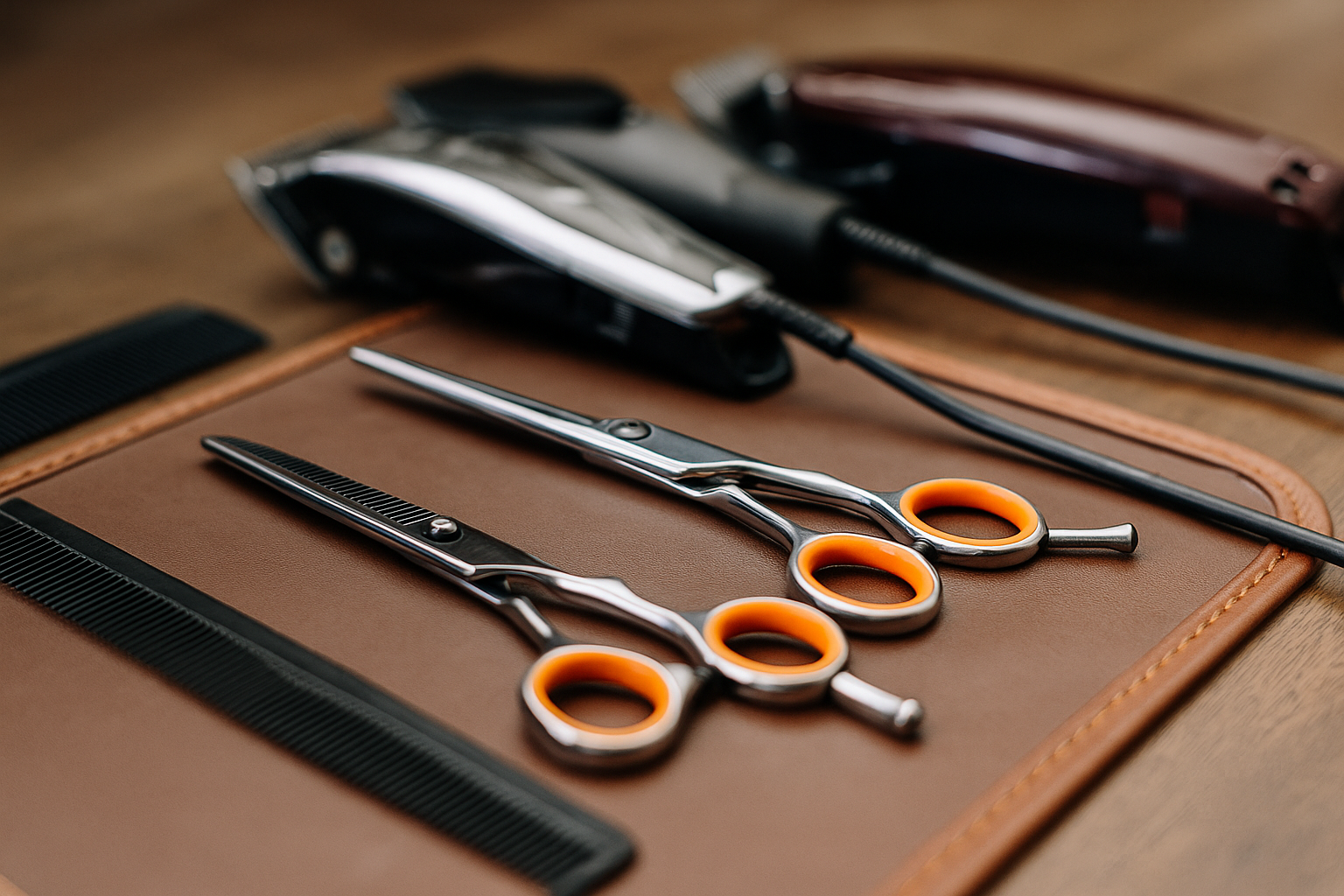
A dog that sits well for a sharp shear can become impossible to groom with a dull one through no change in temperament. The tool changed, not the animal.
What dull shears actually do
The mechanic of a dull shear is different from a sharp one in specific ways. A sharp shear has two cutting edges that meet cleanly along their length. As the blades close, hair is sheared cleanly between the edges with minimal force.
A dull shear has rounded or worn cutting edges. Instead of shearing the hair, the edges pinch and bend the hair. The hair folds between the blades, then either snaps unevenly under continued pressure or slips between the blades unbroken. Common results:
- Multiple snips required to cut what should be a single cut
- Hair folds between the blades and slips through unbroken (the "scissors that won't cut paper" feeling)
- Each cut tugs the hair shaft, transmitting force to the follicle
- The cut line is uneven, ragged, or shows visible "stair stepping" from inconsistent shearing
- The dog flinches or pulls away mid-cut, which then causes the cut line to shift
A dog that sits well for a sharp shear can become impossible to groom with a dull one through no change in temperament. The tool changed, not the animal.
The cycle of slow grooms
Dull shears create a feedback loop that affects every step of the groom:
- Dull shears tug, dog flinches
- You stop, calm the dog, restart
- Each restart takes 10-20 seconds; over a full groom this adds up to 5-10 minutes
- The dog's stress doesn't reset; it accumulates across the session
- By the end of the groom, the dog is significantly more stressed than they would be with sharp tools
- The next time the same dog comes in, they remember the stressful experience and arrive already anxious
- You spend more time settling them, the cycle repeats and worsens
Working groomers in Australia often report that the same dog who used to take 45 minutes now takes 75 minutes. Sometimes the assumption is that the dog has gotten worse with age. Often the more accurate explanation is that the shears have gotten progressively duller and nobody noticed exactly when.
What sharp shears do for you (the groomer)
The benefits to the groomer are often understated because they accumulate gradually. Most groomers don't realise how much harder they're working with dull shears until they get a freshly sharpened set back and feel the difference.
Hand fatigue and RSI prevention
This is the big one for career longevity. A sharp shear closes with very little force; you barely squeeze. A dull shear requires you to squeeze harder to force the cut. After 6 to 8 hours of doing that, hundreds of times an hour, your hands, wrists, and forearms are absorbing serious cumulative load.
Repetitive strain injuries (carpal tunnel, tendonitis, lateral epicondylitis) are common in pet grooming. Sharp tools dramatically reduce the strain that causes them. We have spoken with groomers who attribute their ability to keep working into their 50s and 60s directly to their shear maintenance discipline.
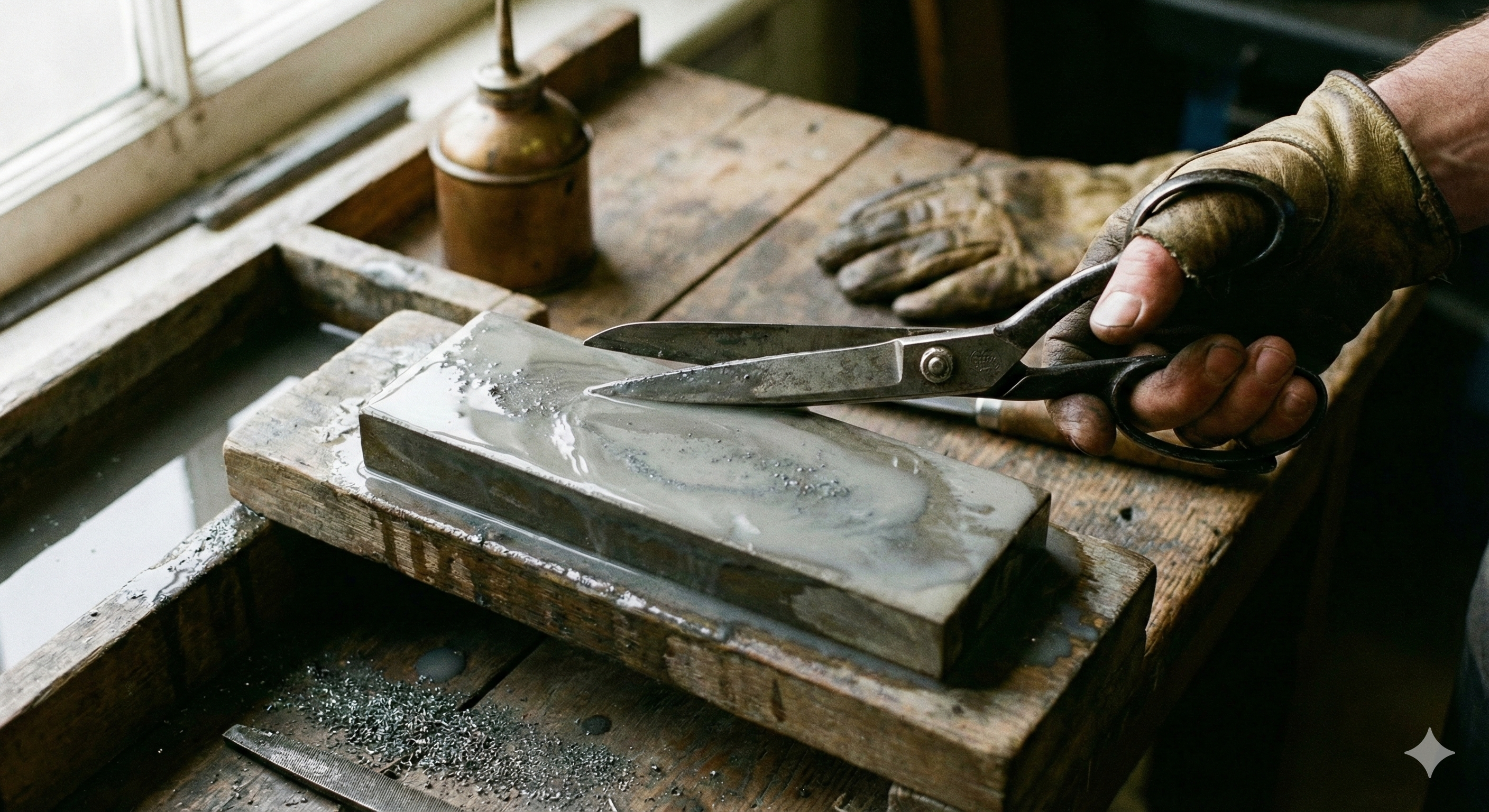
Speed and capacity
A sharp shear simply cuts faster. There's no struggle, no missed cuts, no needing to go back over an area. Working groomers who upgrade their sharpening discipline routinely report 15 to 25 percent faster grooms. Over a working week, that's an extra 4 to 8 dogs at the same daily hours, or the same dogs in less time and more capacity for breaks.
Cut quality
Sharp shears produce cleaner finishes that look better in the salon and photograph better for your portfolio and social media. Owners notice. Repeat business notices. Word of mouth builds. The grooms that look like the photos in your Instagram are the ones cut on sharp shears.
Confidence
Working with sharp tools means you can commit to a cut without hesitation. Dull shears teach groomers to second-guess themselves; you start a cut, feel resistance, hesitate, adjust. That hesitation shows in the finish and erodes your confidence over time. Sharp shears restore the decisive cutting motion that makes good grooms feel effortless.
The business case
For a salon owner, the maths on shear sharpening is straightforward.
A standard grooming shear sharpens for $30 to $40. A premium convex shear for $40 to $60. With proper care, a shear should be sharpened every 4 to 8 weeks of full-time work. That's between $200 and $500 per year per stylist for the sharpening discipline.
Against that:
- 15-25 percent faster grooms across the year is significant capacity
- Better finishes drive repeat business and referrals
- Reduced groomer fatigue means lower turnover and fewer sick days
- Less pet stress builds your salon's reputation as gentle and professional
For a salon billing $80,000+ per stylist annually, the sharpening cost is well under 1 percent of revenue. The performance difference between sharp and dull tools across that revenue is much more than 1 percent.
How often to sharpen grooming shears
For busy salons doing 6 to 10 dogs per day per groomer, every 4 to 8 weeks is typical for the most-used shears. Less-used backup shears can stretch to 8 to 12 weeks. Mobile groomers and home users can stretch further.
The signal isn't a calendar date; it's the early warning signs:
- Hair folding between the blades instead of cutting cleanly
- Needing two snips where one used to work
- Dogs flinching during cuts they used to tolerate
- Cuts looking ragged on a dog whose coat usually finishes cleanly
- Hand fatigue building up faster than usual through the day
Sharpen before these signs, not after.
The two-set rotation
The professional groomer's solution: own at least two of every shear you use most. While one is being sharpened, the other is in active service. You're never stuck with dull tools because there's always a sharp backup.
For a working salon, that means at least:
- Two pairs of straight grooming shears
- Two pairs of curved grooming shears
- Two pairs of thinners or chunkers
- Two finishing shears (your sharpest, most-used pair)
That's 8 shears total, which sounds like a lot but is the normal kit for a working full-time pet groomer. Send half for sharpening every 6 weeks and you'll always have sharp tools without ever waiting for shipping.
What to do when shears arrive in poor condition
Sometimes you inherit shears (from a leaving stylist, a salon takeover, or a second-hand purchase) that are in genuinely bad shape. Heavy nicks, misaligned tips, loose tension. Don't assume they're scrap. Most of these can be restored to working condition.
Send a photo through our contact form and we'll tell you whether it's economic to restore. Sometimes a $30 sharpen plus a $20 tip repair brings a $400 shear back to life. Sometimes it's not worth the work and you should buy new. We'll give you the honest answer.
The bottom line
Sharp shears are kind shears. They reduce pet stress, prevent groomer injury, speed up your work, and produce better-looking finishes. Dull shears do the opposite of all those things, often without the groomer fully noticing how bad it has gotten.
The discipline is simple: own at least two of every shear, sharpen every 4 to 8 weeks of full-time use, and don't wait for shears to start pulling before you send them in.
Our grooming shear sharpening service handles straights, curves, thinners, chunkers, and convex Japanese-style shears. Bulk orders of 50+ items get an automatic 15 percent discount with the same 5-7 day workshop turnaround. Place an order online for instant pricing, or see our dedicated pet groomer service page for the full picture on what working salons typically need.