If you've ever shopped for professional scissors, you've probably seen terms like "convex edge" and "beveled edge." Understanding the difference matters because it determines how the scissors cut, what they cost, who you can have sharpen them, and whether your scissors will hold their performance for 5 years or 25.
This guide explains both edge types in detail, shows you how to identify what you own, and tells you how to protect convex shears from the most common preventable damage in the industry: bad sharpening.
Beveled Edge (German Style)
A beveled edge has a flat angle ground into the blade where it meets the cutting edge. Think of it like a chisel: there's a distinct, measurable angle where steel transitions from the body of the blade to the sharp cutting line. Most German-made scissors use beveled edges, which is why they're sometimes called "German style."
Characteristics:
- A distinct, visible angle where the blade thins to the edge (you can see it as a line under good light)
- More aggressive cutting action that grips and slices through hair
- Common on entry-level and mid-range scissors, plus most barbering shears
- Excellent for blunt cutting, dry cutting, and barbering work
- Easier to manufacture, which is why they tend to be cheaper
- Easier to sharpen and can be restored on standard flat-wheel equipment
Beveled scissors typically cost $80 to $400 in Australia in 2026, depending on the steel grade and brand. Brands you'll commonly see in this category: Tondeo, Jaguar (most lines), Hairart, Henbor, and many of the imported budget brands sold to apprentice stylists.
Convex Edge (Japanese Style)
A convex edge, also called hamaguri (Japanese for "clamshell") or clamshell edge, has a smooth, continuous curved taper from the body of the blade to the cutting line. There is no flat angle, no distinct bevel line, just a gradual mathematical curve.
This is harder to manufacture and significantly harder to sharpen, but it produces a measurably superior cut on hair, especially wet hair and refined styling work.
Characteristics:
- A smooth, curved taper to the edge with no visible bevel line
- Extremely sharp; glides through hair effortlessly with very little force
- Quieter in operation, so less startling for nervous clients
- Used on premium scissors, mostly Japanese-made
- Cuts wet hair cleanly without "pushing" or bending strands
- Excellent for slice cutting, point cutting, texturising, and refined styling
- Requires specialist equipment and skilled hands to sharpen correctly
Convex scissors typically cost $300 to $2,000+ in Australia in 2026. Brands you'll commonly see: Mizutani, Kasho, Joewell, Yasaka, Hikari, Ichiro, Hattori, Belmont, Glamtech, and Mizuho.
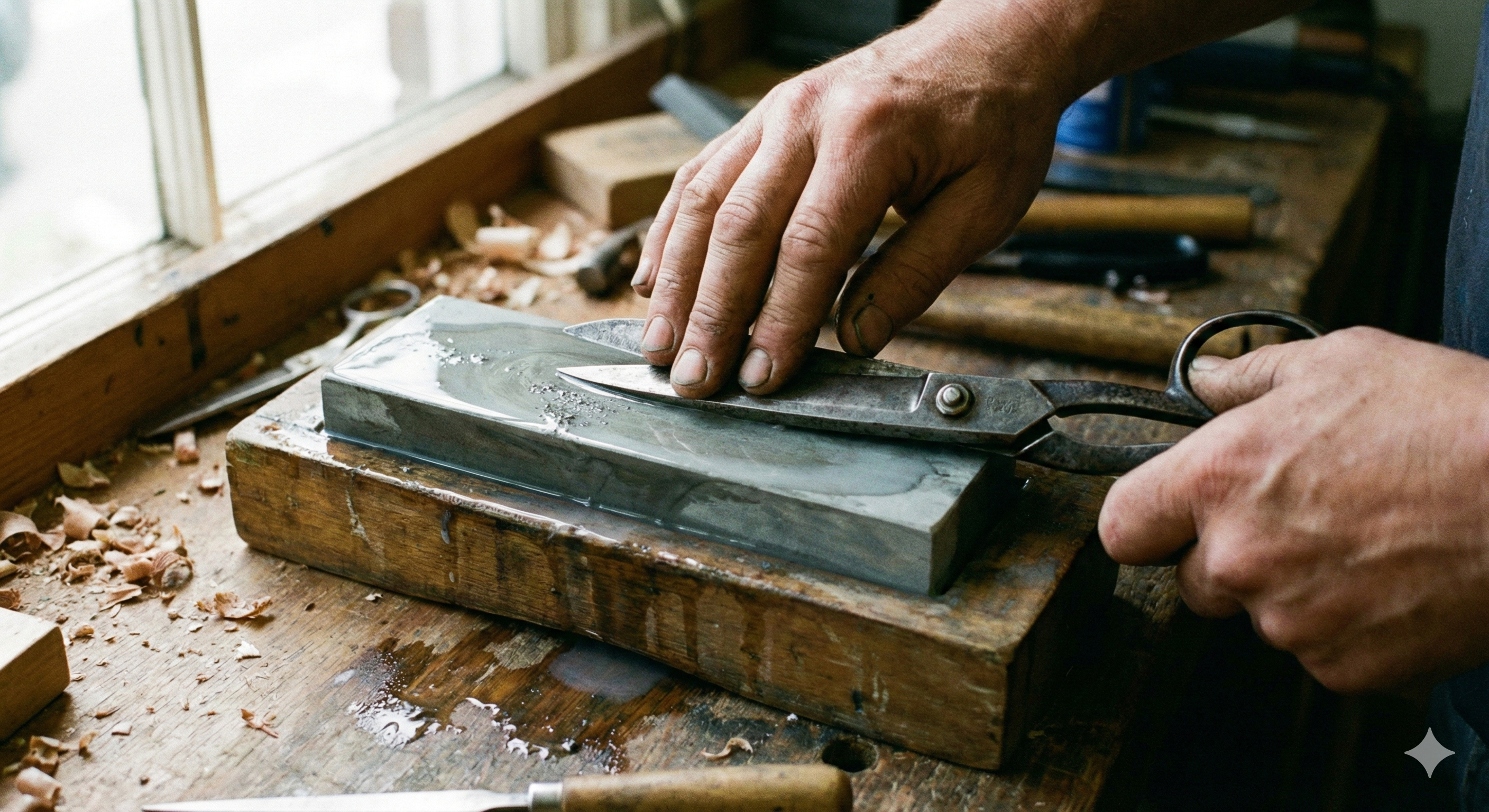
The first flat-wheel sharpen on a convex scissor is the last time it will ever cut like a convex scissor.
Why It Matters for Sharpening
Here's the most important point in this entire article: you cannot sharpen a convex edge on standard flat-wheel equipment without destroying the geometry that makes it work.
Standard sharpening wheels are flat. When applied to a convex scissor, the flat wheel grinds across the curved taper, gradually flattening it into a bevel. The first time you have convex scissors sharpened on flat equipment, you'll often get them back feeling sharper, briefly, because the new edge is fresh. But the curved geometry has been replaced with an angled bevel. The scissors are now beveled, not convex. The unique cutting feel is gone permanently.
We have repaired hundreds of premium Japanese scissors that came in after a "cheap sharpen" elsewhere. Sometimes we can re-establish a working convex curve, but each restoration removes more material from the blade. Two or three flat-wheel sharpenings is often enough to take a $900 Mizutani down to a working life of months instead of decades.
Always ask your sharpener two specific questions before handing over convex scissors: "Do you have convex-specific sharpening equipment?" and "How do you preserve the hamaguri curve?" If they cannot give a confident answer to both, do not give them your scissors. See our dedicated convex sharpening service for what specialist convex restoration actually involves.
How to identify what you own
If you don't already know whether your scissors are beveled or convex, here are four ways to figure it out:
Method 1: Look at the blade in raking light
Hold the scissors so a strong light rakes along the blade at a low angle. If you can see a distinct line running parallel to the cutting edge where the blade thins out, that's the bevel line and you have beveled scissors. If the blade tapers smoothly with no visible line, just a gradual curve, you have convex.
Method 2: Run a fingernail along the back of the blade
Lightly drag your fingernail from the body of the blade toward the cutting edge along the back (not the cutting edge itself). On a beveled scissor, you'll feel a small "step" where the bevel begins. On a convex scissor, you'll feel a smooth, continuous curve with no step.
Method 3: Check the brand
Most major brands are consistent within their lines:
- Almost certainly convex: Mizutani, Kasho (premium lines), Joewell, Yasaka, Hikari, most premium Japanese
- Almost certainly beveled: Tondeo, Jaguar (most lines), entry-level shears under $200, most barbering shears
- Mixed: Some brands offer both. If unsure, refer to method 1 or 2.
Method 4: Send us a photo
If you're still not sure, send a clear close-up photo of one blade through our contact form. We can usually identify the edge type immediately and tell you what to expect on sharpening cost. No quote pressure, just an honest answer.
What if I have damaged convex scissors already?
If your convex scissors have been previously sharpened on flat equipment, the prognosis depends on how many times and how much material was removed. We can usually re-establish a workable convex curve if the damage isn't extreme, but it requires extra material removal and won't be quite the same as factory geometry.
The honest assessment: send a photo with as much detail as you can about the previous sharpening history. We'll tell you whether restoration is worth the cost or whether replacement is the better economic decision. We have no incentive to talk you into work that won't restore the scissors properly.

Cost differences and why
Convex sharpening is more expensive because it takes longer, requires specialised wheels and hand-finishing, and because the work has to be perfect. A flat-wheel sharpening of a beveled scissor is a few minutes of machine time. A correct convex sharpen is significantly longer, with multiple wheel changes, hand-finishing on diamond hones, and a final polish.
In Australia in 2026, expect:
- Beveled hairdressing scissors: $40 to $65
- Convex hairdressing scissors: $75 to $110
- Pet grooming straights and curves (mostly beveled): $25 to $40
- Premium grooming convex shears: $40 to $60
If you're being quoted convex sharpening at under $40, you're not getting convex sharpening. You're getting flat-wheel work that will damage the scissors. See our full Australian scissor sharpening pricing guide for the wider context.
Which edge should you buy?
For your first set of professional scissors, beveled is often the more practical choice. They're cheaper, more forgiving of dropping or rough handling, and easier to find quality sharpening for. Once you have settled into a style and know what kind of cutting you do most, then upgrading to convex is worthwhile. See our first scissors buying guide for the full breakdown.
For experienced stylists doing precision dry cutting, slice cutting, or refined wet work on premium clientele, convex is the right tool. The cutting feel is genuinely different and the results show on a fine cut.
For pet groomers, the practical kit is usually a mix: beveled straights and curves for body work, convex chunkers and finishing shears for face and finishing work. Most working salons end up with both types and sharpen them on appropriate schedules.
Caring for the edge you have
Whichever edge type you own, the same care principles apply:
- Wipe and oil after every client
- Never drop them; even one drop on a hard floor can chip the cutting edge or misalign the pivot
- Never cut anything but hair (no paper, fabric, plastic, thread, or hair extensions with metal weights)
- Store in a hard case, not loose in a drawer or kit bag
- Sharpen at the right interval for your volume (typically 6 to 12 months for working stylists, longer for occasional users)
- Adjust tension regularly
The bottom line
Beveled and convex are different tools for different work. Both can be excellent. What matters most is matching the edge to your cutting style, and protecting whichever edge you choose from being damaged by the wrong sharpening equipment.
For convex (Japanese-style) edges, send them only to a sharpener with convex-specific equipment. Our specialist convex sharpening service preserves the hamaguri curve every time. For beveled scissors, our standard scissor sharpening service handles them at $40 to $65 per pair.
Hairdressers and pet groomers have dedicated guides for the rest of their tool care needs. Place an order online for instant pricing across all scissor types, or send us a message if you'd like edge-type identification before posting.